Project: Iron Horse · Powered Land · For Acquisition
Iron Horse
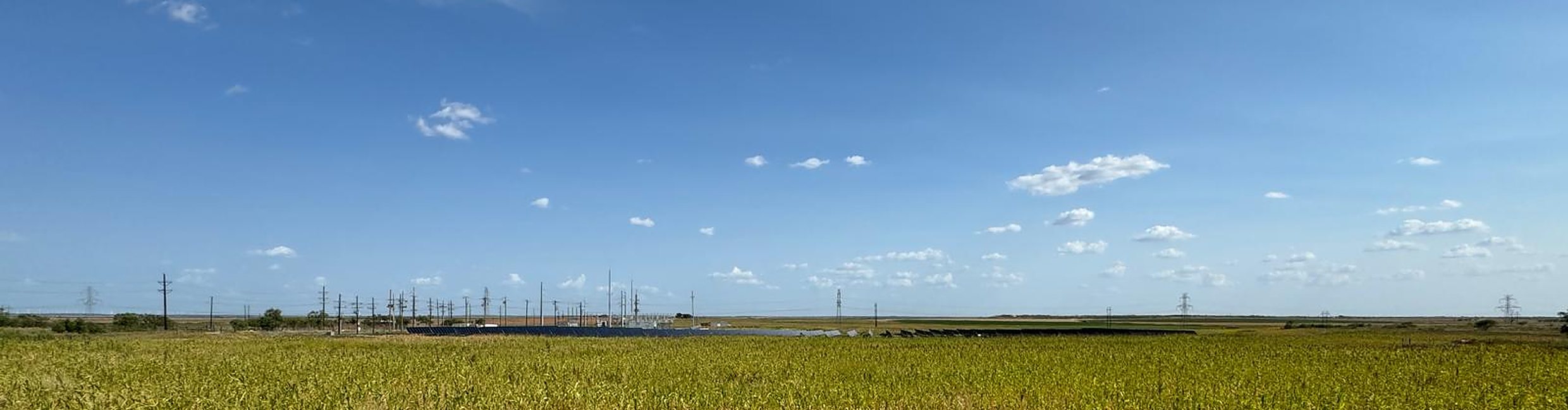
Iron Horse is 2,437 acres of powered land on the I-20 corridor in Mitchell County, Texas: 345 kV and 138 kV transmission crossing the property with two utility substations within about two miles, four gas transmission trunks in reach, documented water underfoot, and Tier 1 fiber up the road. Land, power, gas, water, and fiber, assembled under single control and offered as one position: a behind-the-meter head start.
2,437
acres under control
55 yr
control incl. extensions
~3M GPD
documented well yields
345 + 138 kV
on-site transmission
4 trunks
gas transmission within ~14 mi
250 MW
standard power block
2 GW
scalable campus capacity
24 mo
to first power
~17 ms
to Dallas
The asset
Scarce things on one site: a single controlled block of West Texas land with the transmission, fuel, water, and fiber that take competing sites years to secure. And, if wanted, a group that can power it with you: solar built with our sister company Suniva, and firm generation delivered with our engineering partners.
Site control
2,437 acres under long-term control on the Mitchell and Nolan county line, 1,970 acres suitable for development, with long-tenure leasehold and development rights in place. A paved farm-to-market road bisects the property and connects directly to Interstate 20, three miles north.
Time to power
Power here is built behind the meter: generation and load share the fence, with no interconnection queue between them, so time to power is set by construction, not by a utility study. First power arrives within 24 months of commitment, and the head start conveys with the position. The 345 kV and 138 kV lines crossing the property, with two substations within about two miles, add what most sites lack: built-in grid backup and an export path.
Power
This is a behind-the-meter site: power is generated on the property and consumed on the property, with fuel by pipeline and a generation program in development. The grid plays the role it should: redundancy and export.
Backup and export, built in
Dual voltage classes, 345 kV and 138 kV, cross the campus, with utility substations within about two miles on either side, and an active ERCOT position supports the export path. Redundancy and surplus sales ride on wires that already exist, and none of it sits on the delivery critical path.
Gas by pipe
Four gas transmission trunks run within roughly fourteen miles, and utility gas runs within about three miles of the property, feeding an operating power plant in the same county today. Fuel is phased: first power runs on a short tap to that utility supply, with a trunk lateral built as blocks scale. No drilling, minimal footprint.
Generation in development
A utility-scale solar and battery storage program is in development on the property, with dispatchable gas generation as the firm layer. The mix is built to get cleaner every year: solar and storage grow the share, and high-efficiency generation options are part of the design. Behind the meter, generation and load share the fence, with no queue between them.
Proven power country
Utility-scale wind already turns next door, an operating gas plant runs in the county, and the sun overhead is some of the best solar resource in Texas. Power has been made here for a century.
The offer
250 MW blocks, behind the meter.
Why behind the meter
Power is a bundled capacity product, generated on site and sold as one number. Generation and load share the fence, so delivery never waits in an interconnection queue: that is what makes 24 months to first power possible. The grid does what it should: backup for redundancy, export for surplus.
The fuel story
First power burns utility gas from a short tap about three miles out, alongside solar and storage. Block scale rides a trunk lateral to four gas transmission trunks roughly fourteen miles out, built as blocks commit. Three suppliers are engaged, with West Texas gas upstream: some of the lowest-cost molecules in the country.
Water
The scarcest input in West Texas development, handled with discipline: water on the property is documented, and the development plan is engineered to barely draw on it.
Documented, not assumed
Registered wells, water rights, agreements, and the supply plan are documented and maintained in the data room for qualified review.
Designed for restraint
Development plans use closed-loop, low-draw cooling and generation choices that sip rather than pump, designed for regional water constraints from day one.
The corridor
Interstate 20 runs three miles north at the Colorado City exit: the fiber, freight, and power spine of West Texas, and Iron Horse sits directly on it.
Fiber up the road
Multiple Tier 1 carriers run long-haul fiber along I-20, a lateral of just a few miles from the property, one of the shortest Tier 1 connection paths in West Texas. Dallas and its cloud on-ramps sit roughly 17 milliseconds away, with a second fiber path available on the transmission corridor that crosses the site.
Heavy-haul logistics
Transformers and oversize equipment roll from the interstate to the fence on paved roads with no weight restrictions, with carrier regeneration facilities and rail towns bracketing the county on both sides.
Compute country
More than 4.5 GW of announced compute load sits within 25 miles of the property. The buyers, builders, and power users are already on this corridor, and more are coming.
Community
Development here is built with the community, not on it: local jobs and local investment, water restraint by design, no impact on residents’ power rates, and no taxpayer exposure. Those commitments travel with the land.
The name · Iron Horse
The iron horse is what the cowboys called the locomotive. In January 1881, ranchers organized Mitchell County and chose a railhead camp on the Colorado River as its seat. That April, the Texas & Pacific’s iron horse steamed into Colorado City, and the first boom town in West Texas rose from the tents: the Mother City of West Texas.
We named this ground for the machine that brought power to the land, because the power never left. The rails became the corridor, and the corridor became I-20: the same line that built the town now carries the fiber, the freight, and the power for what comes next.
Data room
Boundary survey, tenure documents, interconnection records, gas and water documentation, fiber engineering, and the development plan are maintained in a complete data room, available to qualified buyers under NDA.
Acquire the position →All figures, capacities, partnerships, timelines, and commitments referenced on this site describe in-development plans and principles. Specific project terms are governed by project-specific agreements with the relevant counties, communities, regulators, and partners. Nothing on this site constitutes a binding offer, contract, or guarantee. While we strive to keep all information accurate and current, the site may contain inadvertent errors or outdated references, and Sunshine DevCo reserves the right to correct or update any information at any time without notice.